Tasersiaq Lake Hydroelectric Project Concept
Revised 6/2024
This concept expands the hydroelectric potential of Tasersiaq Lake, Greenland by collecting melt water, using graded terrace channels cut into the ice, across a wide area of the ice sheet. These man-made stream beds excavated from ice, with non-erosive gentle slopes, follow the contours of the ice sheet. Each will have a cross section suitable to collect and carry natural runoff water from the areas that are most distant from Tasersiaq Lake, and outside of its natural catchment, and continuing along a gentle slope toward the lake where each channel will terminate, directing its melt water stream into the lake catchment. The channels will be widely spaced so that each channel will collect runoff from a large area of ice sheet surface that naturally drains from elevations above the channel. Each channel will collect runoff from a natural ice sheet surface area of approximately 100 km^2.
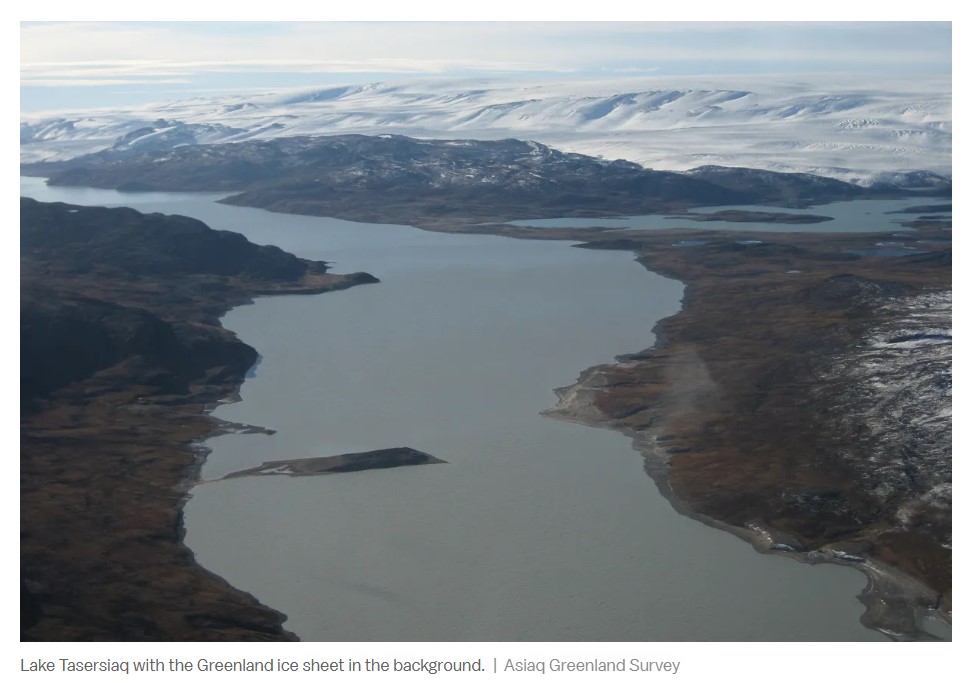
Tasersiaq Lake in southwestern Greenland is a large lake that extends for over 65 km from the western edge of the Greenland ice sheet approximately 100 km south of Kangerlussuaq. It lies at an elevation of 680 m above sea level. The western end of the lake is within 30 km of an ocean inlet, known as Evighedsfjord, that opens into the Davis Strait. The Greenland ice sheet terminates directly along the eastern edge of the lake and its ice-free catchment, for a distance in excess of 30 km. These geographic attributes make it an ideal candidate for hydropower development. The Greenland Minister of Agriculture, Self-sufficiency, Energy and Environment, Kalistat Lund, recently announced that the hydropower potential at Tasersiaq Lake will be launched for tender. [1] The site has previously been extensively studied for hydropower development. A report on the results of that study, prepared by AECOM Tecsult Inc. is available on the Greenland Government website. [2] That study was prepared for ALCOA Aluminum which planned to use the hydroelectric power to supply an aluminum smelter to be located near Maniitsoq, Greenland.
It has been widely reported that the Greenland ice sheet experiences extensive melting during approximately 100 days each summer. The amount of melting is especially large along the southwest parts of the ice sheet near Tasersiaq Lake. Collection of ice sheet melt water over a large area of the ice sheet is a key component of this project concept. The proposed terrace network construction and maintenance techniques are designed to minimize environmental impact to the ice sheet surface. Ice sheet melt water collection will dramatically increase the potential for hydroelectric power generation at the Tasersiaq Lake site.
This project concept proposes to expand the capacity of Tasersiaq Lake by building two asphalt core rock-fill dams. One dam will be at the western end of the lake. A second dam will be to the south of the lake approximately 10 km southeast of the first dam. A penstock tunnel that originates north of the southern dam will carry water from the impounded lake to a hydro powerhouse near sea level approximately 27 km south of the lake. The water delivered to the powerhouse will drive a bank of high-head Pelton turbine generators. The bank of generators will produce electricity running year-round with an expected utilization rate of approximately 95%.
The project that was studied in the 2009 AECOM Tecsult prefeasibility report provided 680 MW of electrical power to a proposed Alcoa Aluminum smelter near Maniitsoq, Greenland. That approach needed two power stations, one at Tasersiaq Lake and a second at Tarsartuup Tasersua to generate the required 680 MW of power. This new approach expands the generating capacity of the Tasersiaq Lake site and eliminates the need for a second, more expensive, power station at Tarsartuup Tasersua. This reduces the capital expenditure required for the project by an estimated $883 million when compared to the original approach. The estimated Internal Rate of Return (IRR) for this lower cost project is 17%. The estimated Average Return on average Capital Employed (ARoaCE) is 15.2% for this 40-year project. See the following page of this website for details: 680 MW Project
For these and many other reasons described in the pages of this website, serious consideration of this project concept is warranted.
Additional Detailed Information
The terrace network needed to collect enough water to power a 680 MW project uses only a fraction of the total potential of the site. Expanding the collection area and associated hydroelectric plant infrastructure can lead to the creation of a much larger power output. A project with a potential to produce up to 2250 MW of electricity is described in detail in the following page of this website: 2,250 MW Project
For detailed information concerning the configuration, size, and estimated cost of the graded terrace networks for both the 680 MW and 2250 MW projects refer to the following page of this website: Terraced Channels
Citations and Links
1. Companies are invited to invest in Greenland’s largest untapped hydropower potentials
2. Tasersiaq, 7e, Greenland Hydropower, AECOM Tecsult Inc. Prefeasibility report 05-18015 Dec. 2009, Data and reports (hydropower.gl)
 Tasersiaq Lake Greenland Hydroelectric Project Concept